CEO’s Wake Up! Operation Ramz, Shadowserver, and the Case for Funding Public-Benefit Cyber Defense
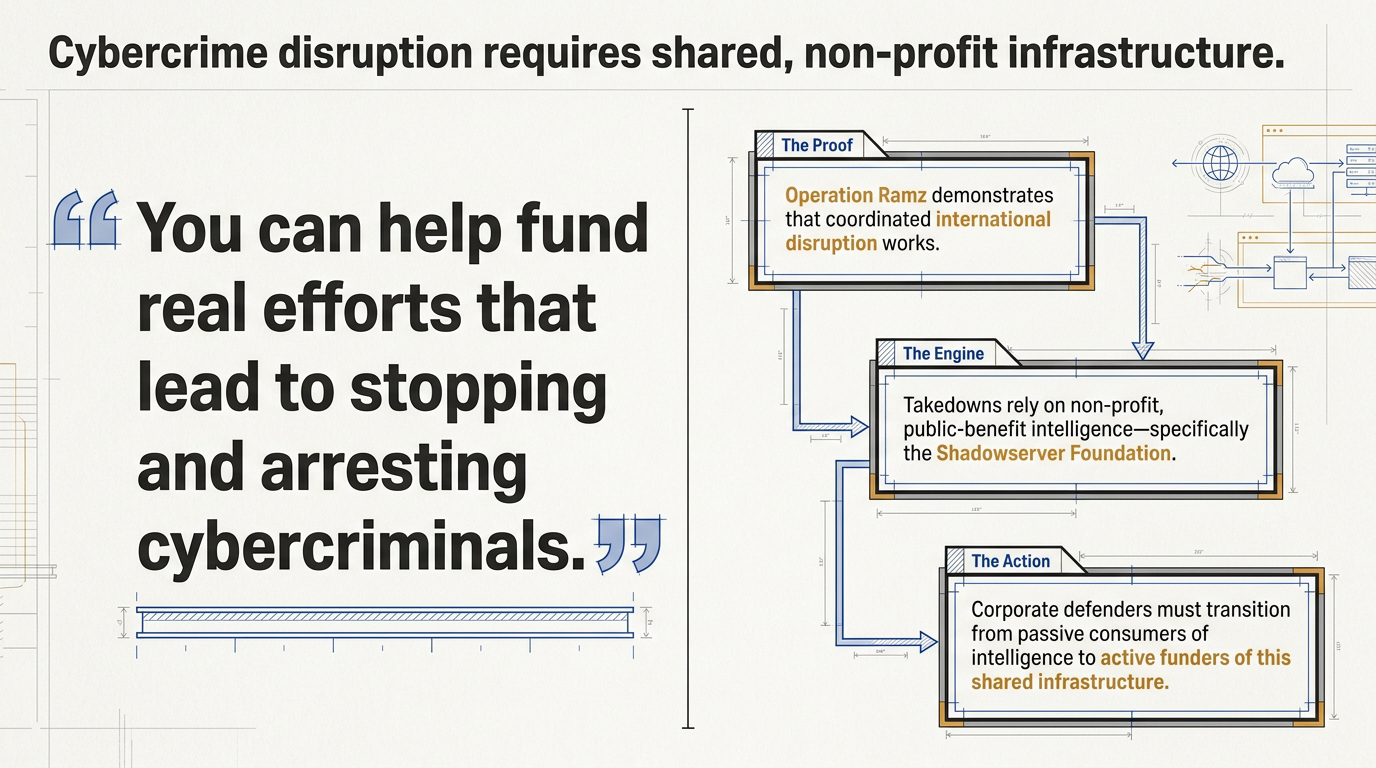
If you are a CEO, CISO, or board member, it’s time to recognize that you can help fund real efforts that lead to stopping and arresting cybercriminals.
Operation Ramz from INTERPOL is a good example of how cybercrime disruption really works. It’s not just one law enforcement action. It’s a team effort built on sharing intelligence, building trust, and having the right infrastructure to work across borders. Shadowserver Foundation is one of the few non-profits with both the technical skills and long-standing law enforcement relationships to support this kind of operation.
Operation Ramz was the first large-scale cybercrime operation led by INTERPOL in the Middle East and North Africa. From October 2025 to February 2026, 13 countries worked together to take down phishing, malware, and scam infrastructure that caused real financial damage. The results: 201 arrests, 382 more suspects identified, 3,867 victims found, 53 servers seized, and almost 8,000 pieces of intelligence shared.

INTERPOL called out the private-sector partners who helped track illegal activity and find malicious servers: Group-IB, Kaspersky, Shadowserver Foundation, Team Cymru, and TrendAI. For Shadowserver, this is not a one-time thing. Sharing actionable intelligence with law enforcement is part of their daily public-benefit mission.

What makes Shadowserver different
Shadowserver is different from commercial intelligence vendors. It’s a non-profit focused on internet-scale visibility, remediation, and victim notification—not selling products. This allows Shadowserver to act as a neutral partner to law enforcement, national CSIRTs, researchers, and network operators.
Shadowserver’s value is both technical and practical. Every day, they scan the internet, run sinkholes, analyze malware, operate honeypots, and send free daily reports to verified network owners and national CSIRTs. The same tools that help law enforcement find malicious servers also help defenders spot exposed systems, compromised hosts, and fix weaknesses before attackers do.
This dual role makes Shadowserver unique. They don’t just watch the internet or help subscribers clean up. They turn internet-scale data into both defensive reports and real support for international investigations.

Why decades of law-enforcement trust matter
Operations like Ramz take time and trust. Multi-country cybercrime takedowns need organizations that can collect reliable data, protect sensitive information, and work quietly with investigators for years. Shadowserver’s long track record with law enforcement is why they keep showing up behind the scenes in major global takedowns.
This history matters. Law enforcement needs more than just raw indicators. They need partners who can provide context, validate findings, and stick with investigations over time—without turning it into a marketing pitch. Non-profits with a public-benefit mission, like Shadowserver, are often better suited for this than commercial vendors, especially when investigations need discretion and persistence.

Operation Ramz proves this point. INTERPOL’s statement was brief, but the results show what happens when investigators and threat intelligence partners work together. The arrests and server seizures were the visible part. Behind the scenes, months of work went into mapping infrastructure, finding victims, sharing leads, and turning technical data into real action.

Why this matters to subscribers
Here’s a practical takeaway: Shadowserver’s daily reports draw on the same data and analysis that underpin major operations like Ramz. If you’re a subscriber, you’re not just getting another list of indicators. You’re getting an outside-in view of what the internet already sees about your organization.
This outside-in view helps organizations of any size. Smaller teams can use Shadowserver reports to focus on basic cyber hygiene and fix issues. Larger teams can use them as an independent check to catch exposures or infections that internal tools might miss. Acting on these reports not only improves your own security, it also reduces the number of vulnerable systems attackers can use.
One key point that often gets missed: local remediation and international disruption go hand in hand. When you act on a Shadowserver report, you help shrink the space cybercriminals can operate in. Operation Ramz shows what’s possible when enough intelligence, trust, and coordination come together.
Why the Alliance matters
The Shadowserver Alliance is a way for organizations to move from just benefiting to actively supporting the mission. Instead of relying solely on reports, Alliance members help fund the expert staff, scanning systems, sinkhole monitoring, and data processing that make Shadowserver’s work possible. This funding matters because running at internet scale requires real resources, and the benefits extend to governments, CSIRTs, and private defenders everywhere.
In practice, Alliance support keeps Shadowserver’s non-profit capacity strong, enabling law enforcement to rely on it during major operations. It also helps keep Shadowserver independent by spreading support across many partners. If your organization cares about fighting cybercrime, joining the Alliance is a way to invest in shared infrastructure that leads to takedowns, victim notification, and real action against threat actors.

There’s a strategic point here, too. Most organizations spend on internal tools, but few budget for public-benefit systems that help everyone track and disrupt malicious activity. Operation Ramz shows these systems are not just theory—they lead to arrests, server seizures, and victim identification. If cybercrime is a real board-level concern, supporting the non-profit infrastructure that makes this possible should be a priority, not an afterthought.

How organizations can learn more
If you want to learn more about the Shadowserver Alliance, start with the Become a Partner page (https://www.shadowserver.org/partner/). It explains the Alliance’s purpose, how partnerships support Shadowserver’s work, and what kinds of support are available. You’ll also find materials and funding information to help you get started.
Ready to take the next step? If your organization wants to explore membership, sponsorship, grants, or other ways to support Shadowserver, reach out through the website’s contact page or email contact@shadowserver.org. For decision-makers, this is the fastest way to move from interest to real engagement.
A question worth asking the members of the Board of Directors
Operation Ramz proves that public-benefit cyber defense leads to real results when intelligence, partnerships, and law enforcement work together. But here’s the bigger issue: many organizations benefit from shared intelligence and remediation, but not enough help fund the non-profit work that makes it possible.
This raises a tough but important question. If the organizations most worried about cybercrime know how big the problem is, why aren’t more of them investing in the non-profit infrastructure that turns intelligence into arrests, takedowns, and victim protection?
Supporting the Shadowserver Alliance won’t solve cybercrime alone, but it’s a practical way for organizations to back the kind of expert, public-benefit action that makes operations like Ramz possible.

Here are a couple of slide decks to help make the case for funding and supporting the Shadowserver Alliance.
- Architecting Global Cyber Disruption – An Executive Briefing on the Public Benefit of Cyber Civil Defense
- Intelligence to Arrest: The Business Case for Public-Benefit Cyber Defense – Deconstructing INTERPOL’s Operation Ramz and the hidden infrastructure powering the global cybercrime disruption.